From issue to reviewed
pull request
AI4TEST plans the work, writes the code and the tests, runs them in an isolated sandbox and re-runs until they are green — then opens a pull request for you to review.

What AI4TEST does
An engineering teammate that never skips the tests
Every screenshot below is the real product, not a mockup.
Issue to pull request
Describe it once. Review the diff.
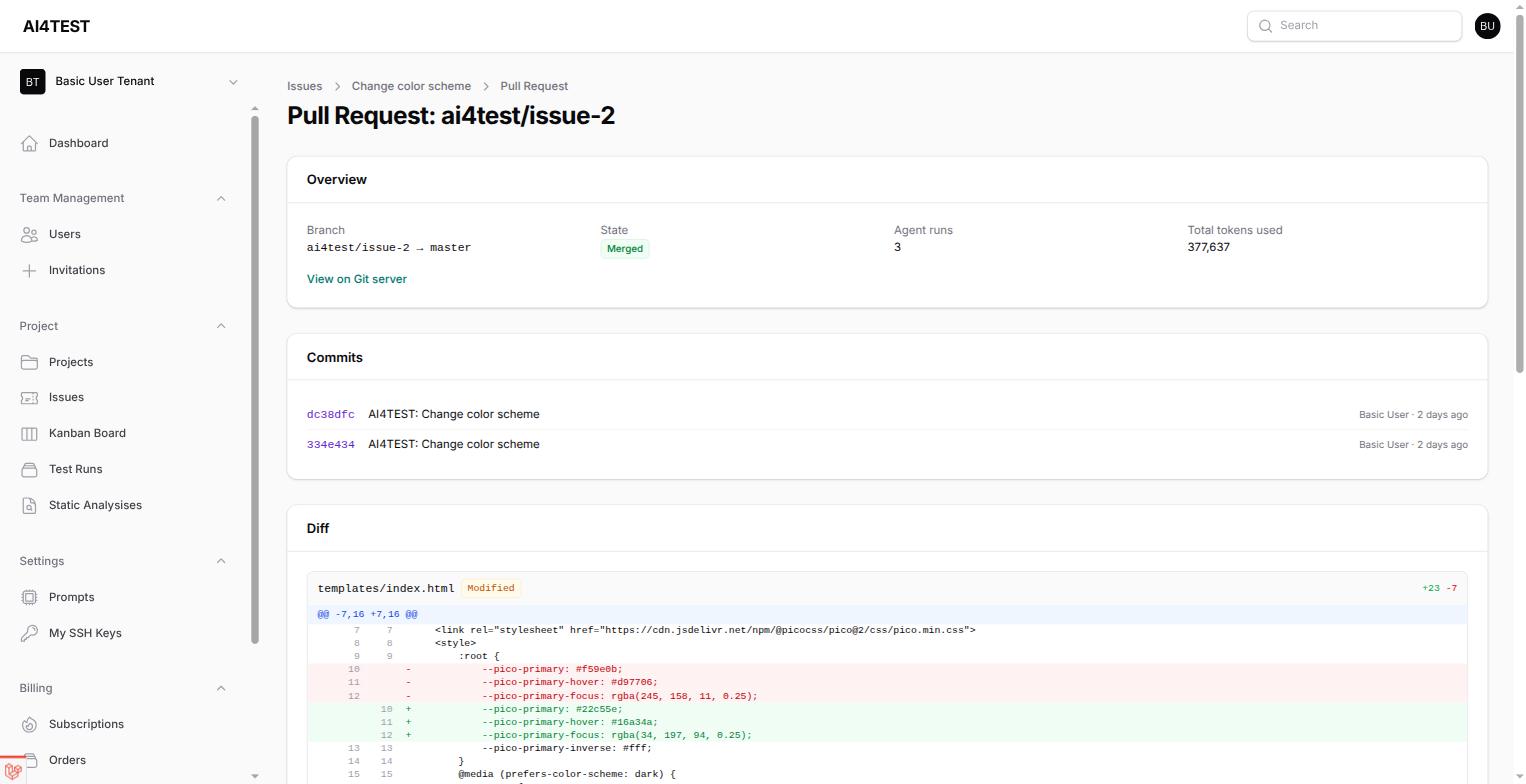
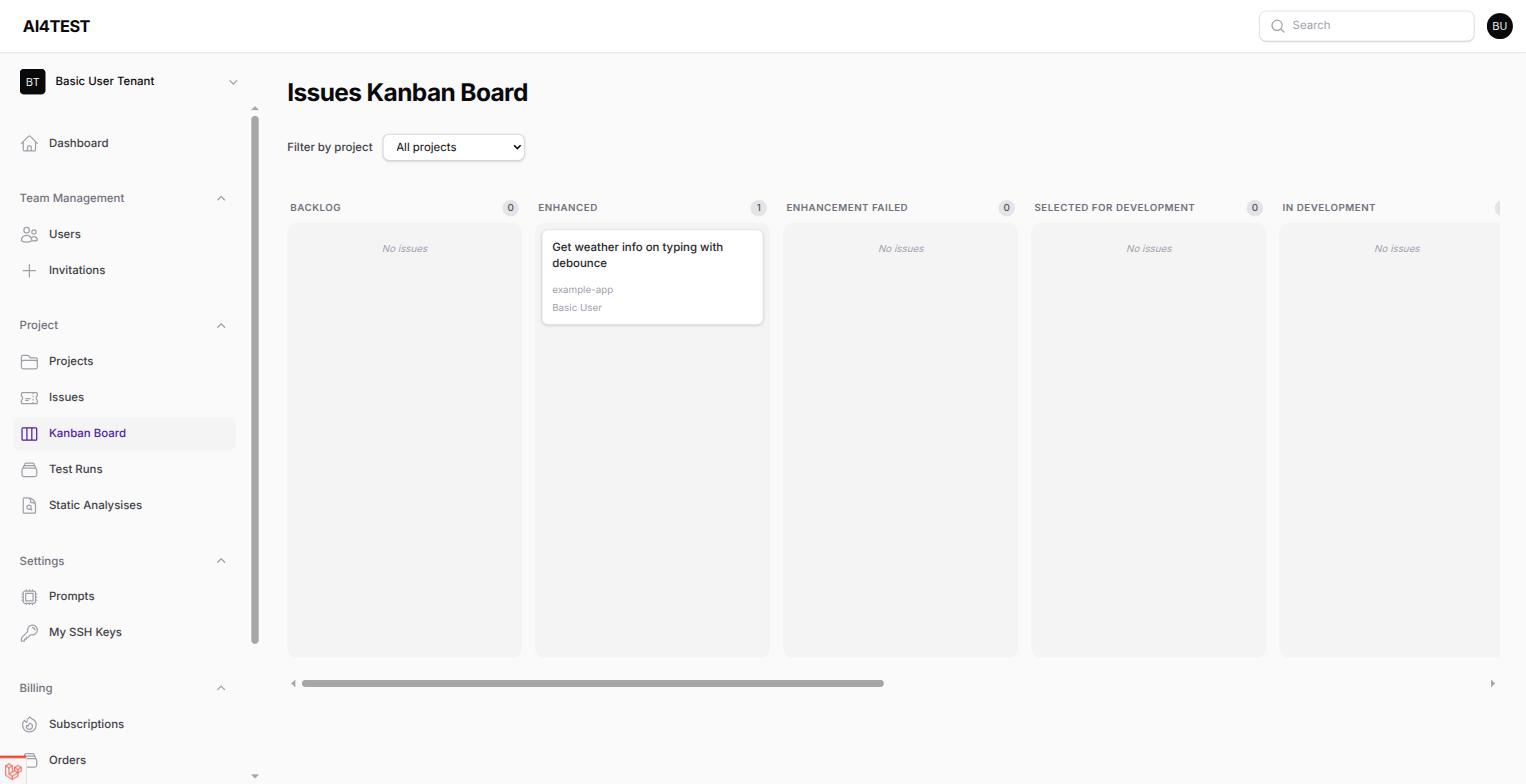
Write an issue in plain language. The agent enhances it into a concrete specification, gets your approval, implements it on a branch and opens a pull request — commits, diff, agent runs and token cost all in one view.
- Backlog → Enhanced → In development → Merged, on a Kanban board
- Request changes with comments and let the agent steer on them
- Nothing lands without your approval
Self-healing test runs
Green tests, without the babysitting.
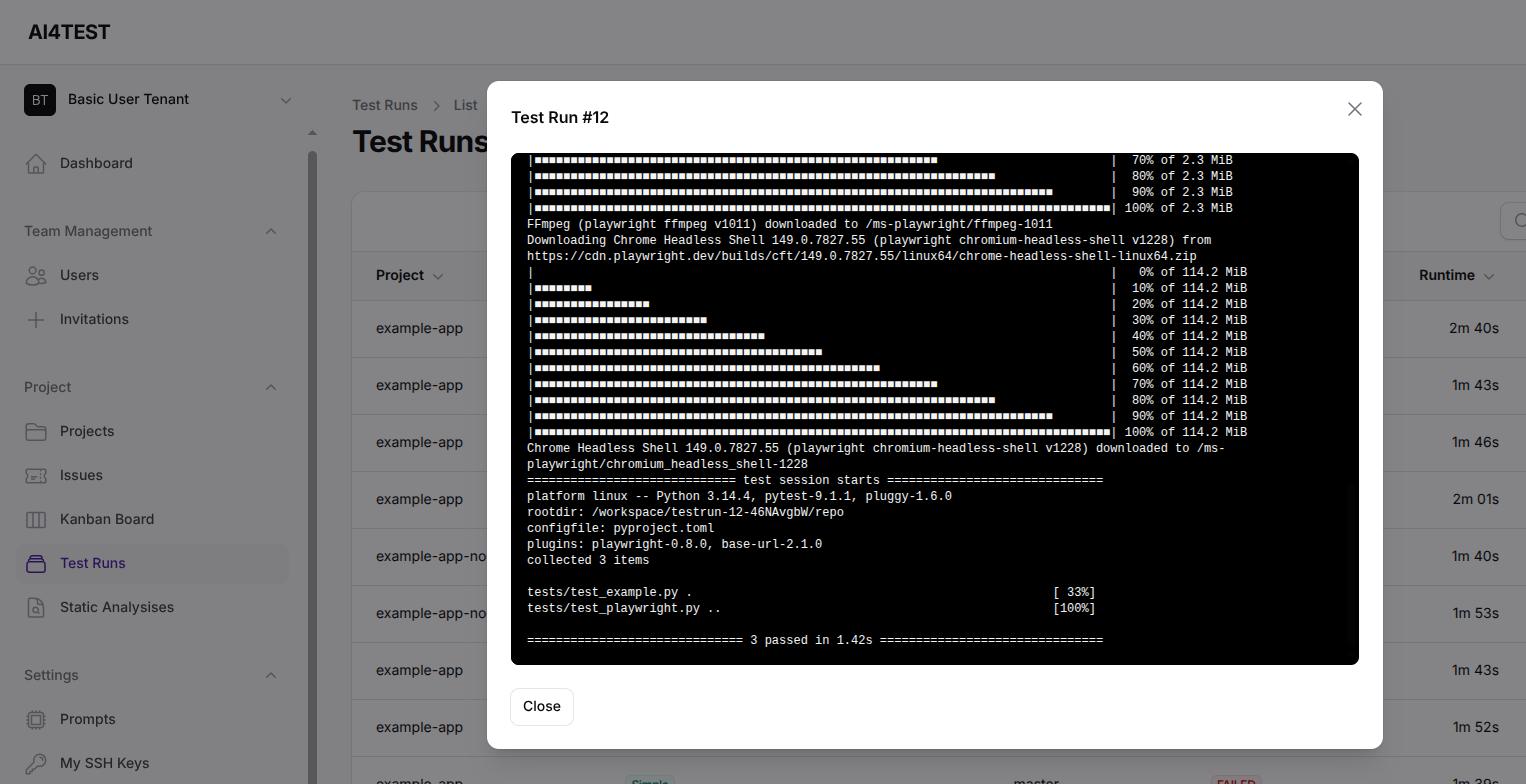
Every run happens in a disposable sandbox built from your own image — Python 3, Node 24 or your own — with your before-script and test command. Stream the log while it runs.
When a test breaks, the agent reads the failure, fixes the cause and runs again, up to the retry budget you set per project. Flaky selectors and drifted fixtures stop being your problem.
Static analysis agent
Findings you can act on.
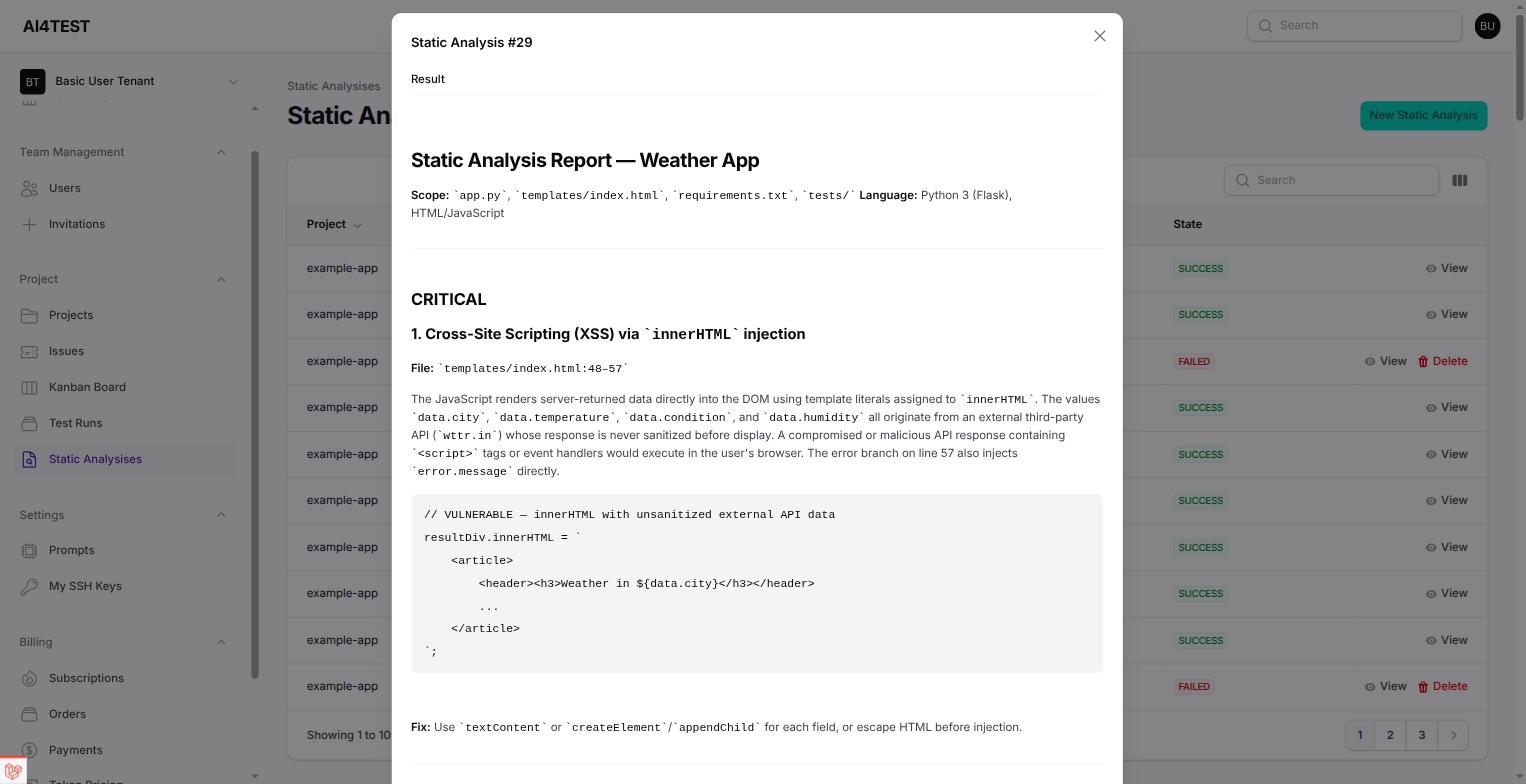
Point the analysis agent at a branch and get a report that names the file and line, explains why it is a problem, shows the offending snippet and proposes the fix — graded from critical down to nit.
Run it on demand, keep the history, and turn any finding straight into an issue.
Full audit trail
Every run, every token, accounted for.
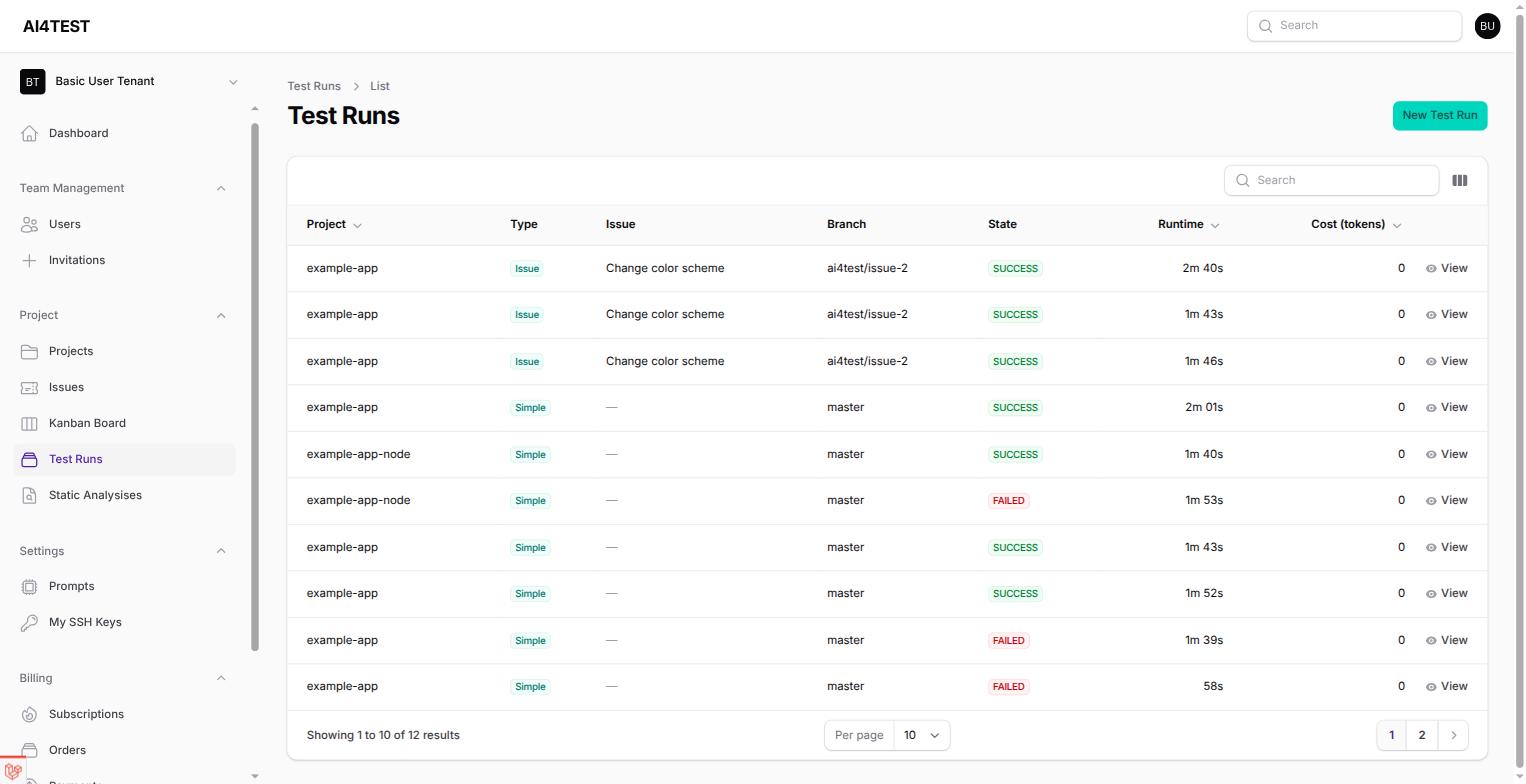
See each run with its branch, state, runtime and token cost. Token usage and pricing pages show exactly what the agents spent, so AI budget stops being a mystery line item.
Bring your own repository
Set it up in one screen.
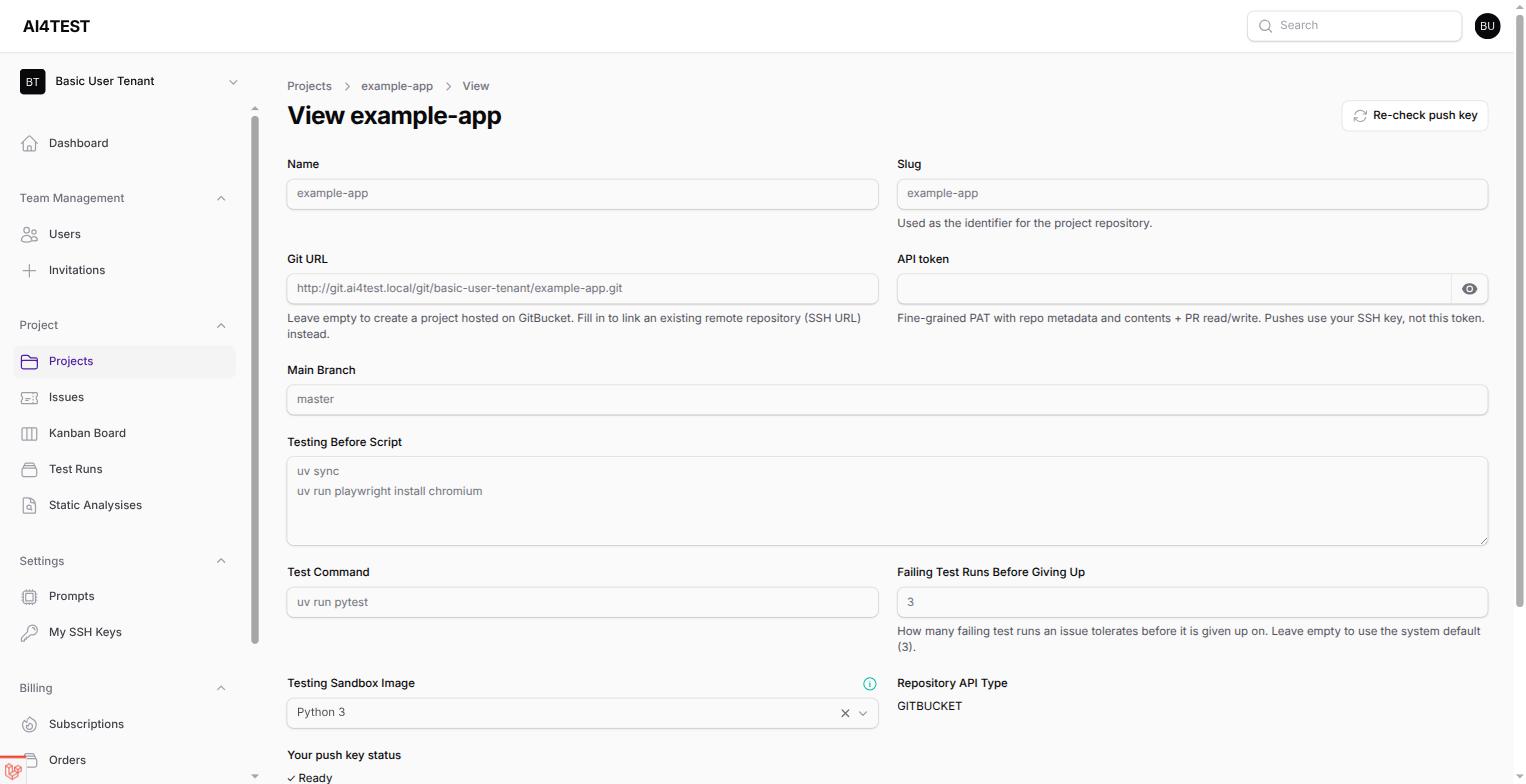
Connect an existing Git remote over SSH or host the repository with AI4TEST. Set the main branch, before-script, test command, sandbox image and retry budget — then upload your specification documents so the agents work from the same source of truth you do.
And the rest of the toolbox
Built for real teams
Specification comparator
Upload the spec, and let AI4TEST tell you where the implementation drifted away from it.
Your prompts, your rules
Override the agent prompts per workspace to match your conventions, stack and definition of done.
Workspaces & roles
Invite your team, scope permissions with roles, and keep every project isolated per workspace.
Isolated sandboxes
Agents run inside throwaway VMs. Your code never shares a machine with anyone else's.
Token budgets
Per-workspace token wallet, transaction history and pricing — no surprise bills at the end of the month.
SSH keys & Git hosting
Push keys managed for you, with a built-in Git server if you would rather not connect an external one.
What teams say after a month with AI4TEST
We stopped arguing about who writes the tests. The agent writes them, the sandbox proves them, and code review is finally about the design again.

“Our regression suite used to rot between releases. Now the agent fixes the selector, re-runs, and I just read the diff over coffee.”

“The static analysis report caught an XSS in a template nobody had opened in two years. It pointed at the exact line and handed us the fix.”

“What sold the team was the audit trail. Every agent run, every token, attached to a pull request we approve ourselves.”

“We pointed it at a legacy Flask app on a Friday. By Monday it had coverage we had been postponing for three quarters.”

Boring where it counts, sharp where it matters
A battle-tested Laravel core, agents on top, and sandboxes that keep the two apart.




Pay for agent work, not for seats you forgot about
Start free, add tokens when the agents start pulling their weight.
Token pack 10M
One time product
- Amazing Feature 1
- Amazing Feature 2
- Amazing Feature 3
- Amazing Feature 4
- Amazing Feature 5
HUF 10,000.00
Get Token pack 10M NowToken pack 1M
One time product
- Amazing Feature 1
- Amazing Feature 2
- Amazing Feature 3
- Amazing Feature 4
- Amazing Feature 5
HUF 1,000.00
Get Token pack 1M NowToken pack 5M
One time product
- Amazing Feature 1
- Amazing Feature 2
- Amazing Feature 3
- Amazing Feature 4
- Amazing Feature 5
HUF 5,000.00
Get Token pack 5M NowGot a question?
The things engineering teams ask us before they connect their first repository.
AI4TEST is an AI test automation and self-healing platform. You connect a Git repository and describe what you want; the agents turn the issue into a specification, implement it on a branch, write and run the tests in an isolated sandbox, repair failures, and open a pull request for your team to review and merge.
When a test run fails, the agent reads the failing output — not just the exit code — works out whether the test or the code is wrong, applies a fix and runs the suite again. You set how many failing runs an issue may burn through before it gives up and hands the problem back to you (the default is three).
Anything that runs in a Linux container. Each project picks a sandbox image (Python 3 and Node 24 are ready to go), a before-script and a test command — for example "uv sync && uv run playwright install chromium" followed by "uv run pytest". Playwright, pytest, Jest, Vitest and PHPUnit all work the same way. Bring your own image if you need a different toolchain.
No. The agent stops at the pull request. You see the branch, the commits, the full diff, the test runs behind it and the tokens it spent, and you either approve, request changes with comments the agent then acts on, or reject the work.
Agents work inside disposable, per-run sandboxes that are destroyed when the run ends — your repository is never on a shared machine with another customer. Your code and documents are used to complete your runs only; they are not used to train models.
No. Point AI4TEST at your existing remote over SSH — we manage the push key for you — or leave the Git URL empty and let AI4TEST host the repository for you. Pull requests are created on whichever side hosts the code.
It reviews a branch and produces a graded report: severity, file and line, an explanation of the risk, the offending snippet and a concrete fix. It is the reviewer that never gets tired on the eight hundredth file — useful for security issues, dead code and silent regressions.
Upload your specification documents to a project and AI4TEST indexes them, then compares what the code actually does against what the spec says it should. It is how you catch the requirement that quietly went missing three sprints ago.
Agent work is paid for in tokens from your workspace wallet. Every test run, static analysis and pull request records what it consumed, and the token usage and pricing pages show the full history — so a surprising invoice always has a traceable cause.
Yes. Prompts are editable per workspace, so you can encode your coding standards, preferred test style, framework conventions and definition of done. Combined with per-project sandbox settings, the agents work the way your team already works.
Workspaces are shared. Invite teammates, assign roles and permissions, and keep projects, wallets and runs scoped per workspace. Everyone sees the same board, the same runs and the same costs.
Write to us at ai4test@itware.hu, or open a suggestion on the roadmap below — feature requests are prioritised by upvotes.
What we are building next
Upvote what would help you most, or suggest something we have not thought of. The loudest votes get built first.
Notes on testing, agents and shipping
Machine Learning Models for Test Flakiness Detection and Prevention
Machine Learning for Defect Prediction: Early Bug Detection Strategies
Self-Healing Tests: Reducing Maintenance Overhead in Automated Testing
Give the agent your worst test suite
Connect a repository, open one issue, and see what comes back as a pull request. No credit card required.